Railcar Management
Real-time tracking of railhead status, inventory, and historical movement data for rail-based logistics.
What It Does
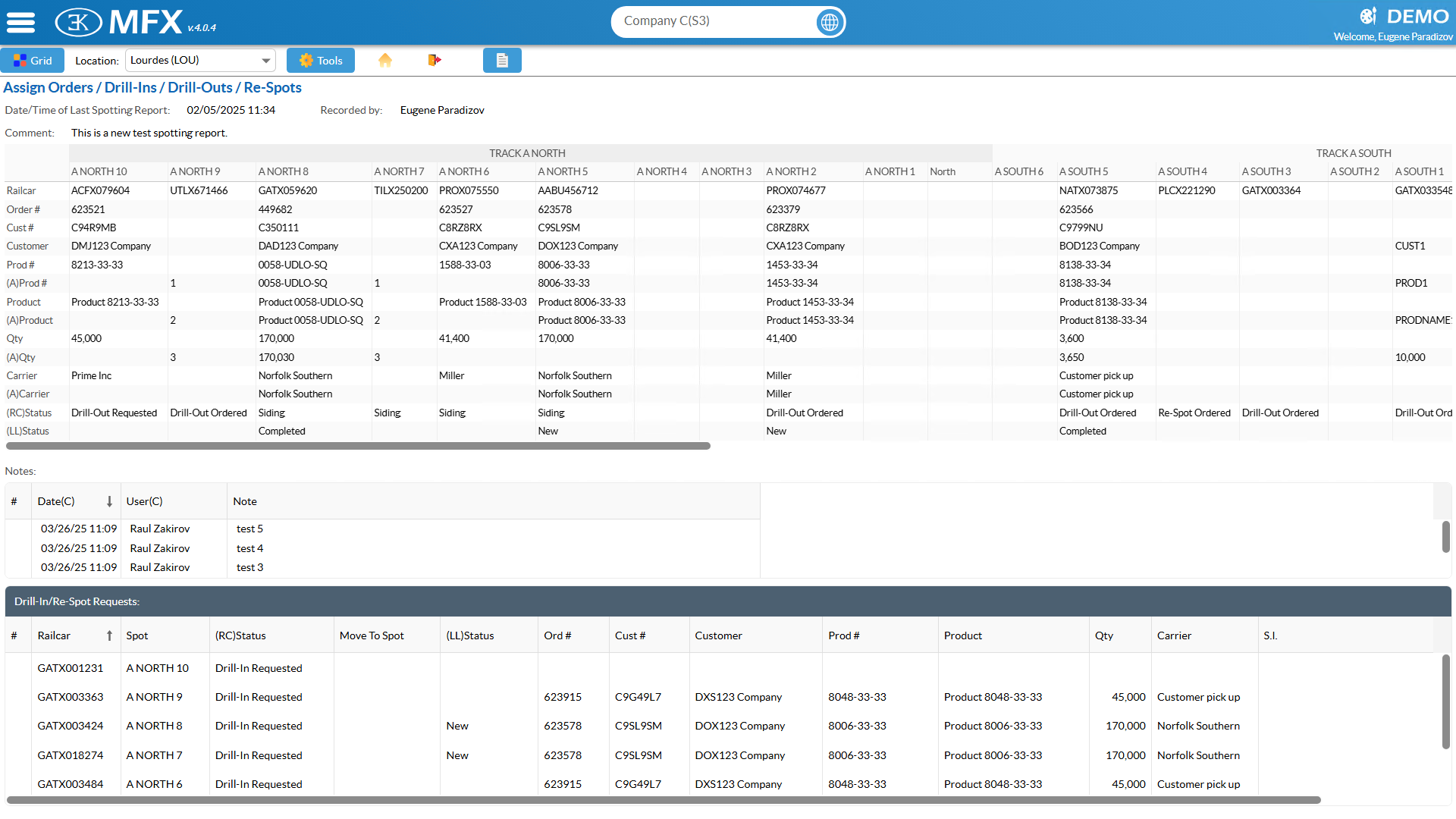
Railcar Management replaces siding whiteboards with a permanent, timestamped record of which railcar is at which spot. Drill-In and Drill-Out requests follow a structured workflow that generates the railroad move document automatically — every spotting event has a searchable, shift-proof record.
Spotting Reports & Drill Workflows
Operators walk the track at shift transitions and assign each car to its physical spot. Drill-In and Drill-Out requests specify the car, target spot, and shipping order; the RCDIDO screen generates the FAX document the railroad needs to execute the move. Re-spots follow the same path — structured request, formal order, permanent record.
Railcar Master & Outage Tables
Each car carries a master record: industry reporting mark, car type, lining specification, rental contract dates and rate, total capacity, customer exclusivity, and a linked outage table. Outage tables translate a dip stick reading into gallons for that car's specific geometry, eliminating manual interpolation from a paper chart.
13-State Lifecycle & Audit Trail
Every status transition — drill-in order, loading event, re-spot, or administrative override — atomically updates the master record, creates an immutable history entry, and writes field-level before/after changes to the audit trail. The lifecycle covers thirteen defined states from Siding through Loaded, Drill-Out Ordered, Away, and Returned. Loading Log transaction status surfaces directly in RCM grids.
See RCM in Your Operation
Schedule a demo and we'll walk through Railcar Management alongside the full TMS suite — and where it fits in the AI-Native platform we're building.